

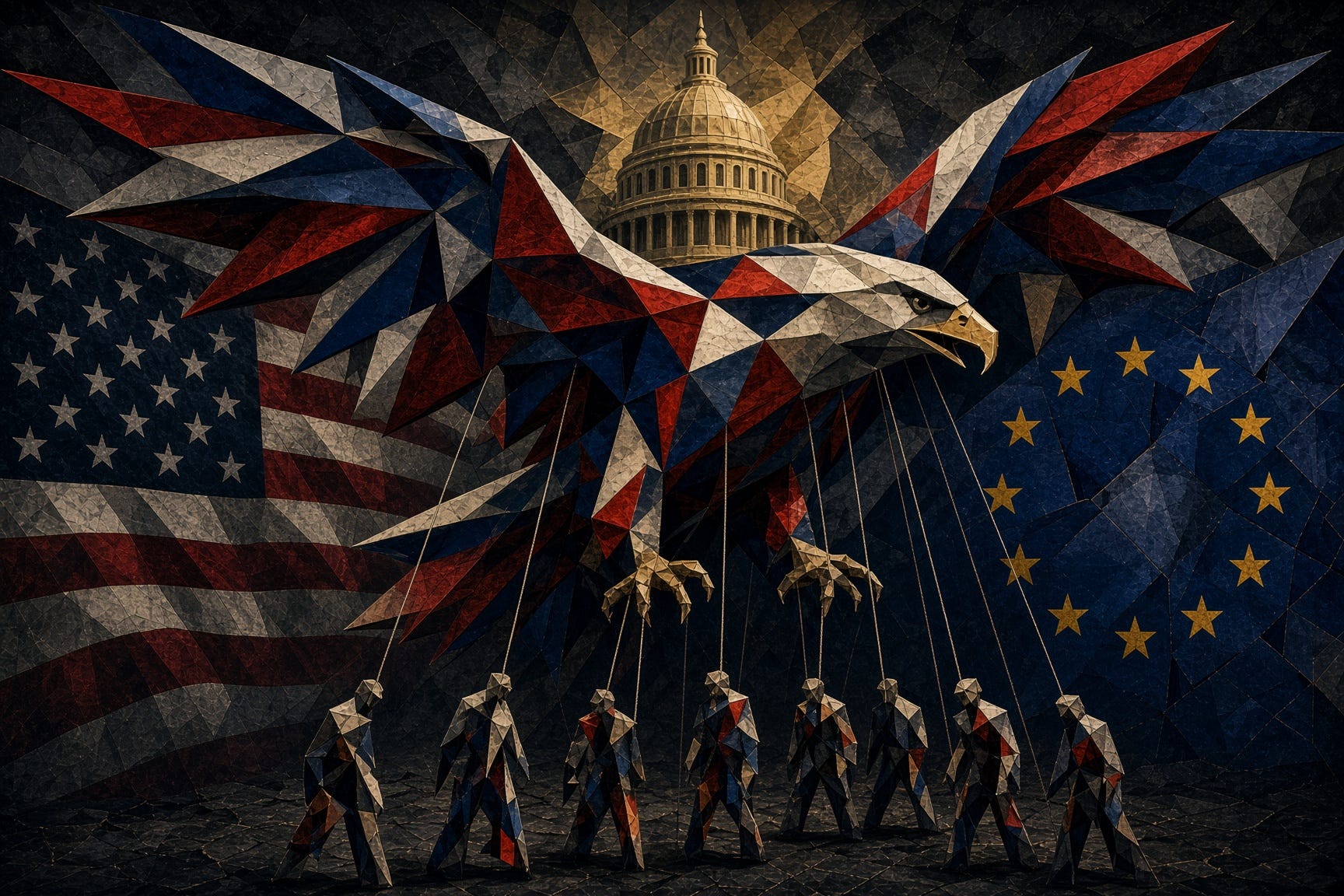
Sakari Linden examines how the United States uses liberal ideology and an artificially constructed Western identity to secure its hegemony and reduce European states to obedient vassals.
Introduction
The hegemonic aspirations of the United States are a challenge for international security, peace, and stability. The counterforces to these hegemonic aspirations are sovereign equality of states, balance of power, and multipolarity, nowadays promoted by, for example, China and Russia.
In the rational world, states make calculated, self-interested decisions based on available information to maximize benefits, focusing on strategic choices between cooperation and conflict. However, Western foreign policy, particularly in Europe, has become irrational due to ideological fundamentalism rooted in liberal hegemony and Manichean narratives, leaving less room for resolving conflicts through compromise.
Western identity, through the liberal ideological mission, has enabled the US to control the wide community of countries that belong to the collective West. Western identity subordinates many countries to US interests and prevents them from acting in a sovereign manner and according to their national interests.
The Liberal Ideological Mission
The Peace of Westphalia in 1648 raised sovereignty, balance of power, and noninterference in internal affairs as central principles of the international political system. Hegemony represents a conception of international order opposed to the principle of sovereign equality among states. It rejects the balance of power in favour of an approach intended to reduce international anarchy and promote human freedoms.
The liberal ideological mission is an example of a hegemonic project. It adopts a Manichean worldview in which competition within a balance-of-power system is interpreted as a struggle between good and evil. Therefore, this feeling of moral superiority leads to a reluctance to compromise. Before the liberal ideological mission, the feeling of Western superiority had many manifestations, such as the British “White man’s burden” and the French “civilising mission”.
The current hegemonic project of the United States started with the Wolfowitz Doctrine for global primacy. The Defense Planning Guidance of February 1992 outlined a hegemonic world order. Brzezinski’s grand strategy was a central piece of the new Western liberal ideological mission. It aimed to ensure that no Eurasian challenger emerges. It also aimed to maintain collusion and security dependence among the vassals, keep tributaries pliant and protected, and keep the barbarians from coming together. According to Brzezinski, “the US must keep Eurasia divided into as many different powers as possible”. Accordingly, the US pursued military containment through NATO expansion in Europe against Russia and through the pivot to Asia against China.
The Impact of Western Identity
The term “identity” describes sameness with oneself, i.e. those characteristics defining the uniqueness of one individual. Simultaneously, it implies differences from others. In addition to social elements, identities also contain non-social ones, which prevent them from being infinitely malleable. Size, race, ethnicity, geography, traditions, and language are examples of physical, cultural, and historical characteristics that strongly resist change.
A state must distinguish its “friends” from its “enemies”. A common identity thus binds a state to its allies. Group identification of a state is a process which determines to which category, in-group or out-group, other states belong in its classification. Group identification contributes to close international cooperation, whereas a lack of group identification makes such cooperation less likely.
States are wary of entering cooperative arrangements because they want to avoid diminishing their freedom of action in the future. However, if group identification between certain states is strong enough, they can enter into close cooperation, which differs from other cooperative agreements in its intensity and intrusiveness upon the states involved.
Western culture is based on shared legal and political traditions, such as Roman law, political democracy, parliamentary institutions, and religious and cultural traditions, like Christian ethics, Renaissance humanism, rationalism and empiricism, and romanticism and classicism. Western identity is strongly bound to European identity, from which it has spread to North America, which is an essential part of a geographical area acknowledged to form the West, as well as to Latin America. Furthermore, Western influence has spread especially after the Second World War to some Asian countries, notably to Japan and South Korea, which has created an area sometimes called the wider West.
The West is composed of countries that partially share traditions and cultural heritages. It is striking that even Europe is not uniform from a religious, ethnic, and linguistic point of view. In religious terms, the West emphasises Catholicism and Protestantism, and in ethnolinguistic terms, Germanic and Romance peoples and languages, often at the expense of Eastern Orthodoxy and Slavic peoples and languages.
The founders of NATO intended the military alliance to be the flagship institution for building a transatlantic security community of like-minded democracies, in addition to its mission of countering the threat created by the Soviet Union. Its mission was to achieve positive identification among NATO members. American policymakers saw that a key to success in this project was not only to incorporate and democratise Germany, but to forge a common identity between West Germany and the West.
Realist scholars of international relations have been sceptical about the endurance of the alliance between Germany and the United States. Structural realists assume that states are self-interested, security-seeking actors, who exist in a condition of anarchy, and who measure their success and each other in relative power terms.
The endurance of Germany’s alignment with the West, the US, and NATO can be explained through positive identity formation, which has created a shared sense of history and destiny. In this positive identity formation process, Germany’s institutions were altered from the bottom up, its education system was modified, its economy was changed, and its political system was completely overhauled. West Germany’s first post-war leader, Chancellor Konrad Adenauer, said that the German people “must be given a new ideology”, i.e. Western liberal democracy.
As a result, the West German elites and the public changed the way they perceived the West, and especially the United States. This process created a sense of “solidarity, community, and loyalty” between Germany and its transatlantic allies to such an extent that Germany shares with its Western partners a positive identity that transcends relationships built on particular interest calculations.
The German-American special relationship was based on the United States’ status as the ultimate security guarantor in the relationship. The dominant military role of the US created a protector-protectee relationship in matters of military security, which could change at some point and erode the whole system. The first signs of a possible future erosion of the transatlantic special relationship were visible already in the 1990s in the form of the German New Right’s rhetoric, which developed revisionist feelings concerning Germany’s rights as a sovereign state with unique interests and a distinct German identity.
Other signs of this erosion are also evident in the current state of transatlantic relations. The US and the EU now demonstrate less cohesion and are less capable of acting together as successful ordering agents than in the past. Even the whole idea of a unified “West” is increasingly being questioned on both sides of the Atlantic.
Conclusion
The United States has tried to achieve the status of hegemon in the world order since the end of the Cold War. It has used the notion of a liberal ideological mission to strengthen a common Western identity and extend its reach beyond the Western core, including to countries outside Europe and North America.
Western identity based on the liberal ideological mission is an artificial construct, shaped through deliberate identity formation and historical education, as demonstrated by the example of West Germany after the Second World War. Significantly, this process took place in a country already belonging to the core of Western identity through its Germanic heritage and Catholic-Protestant traditions. It is important to notice that there is less Euro-Atlantic sentiment and less Russophobia in East Germany, where there was no positive Western identity formation during the Cold War. This process of deliberately constructing Western identity becomes more pronounced the further a country’s linguistic, cultural, and religious background is removed from the core of Western identity. These deeply rooted characteristics resist change, making them more stable sources of identity than social elements such as political ideology.
The liberal ideological mission serves to draw countries whose linguistic, cultural, and religious backgrounds are more distant from the core of Western identity into the collective West’s sphere of influence, thereby reinforcing the hegemonic project of the United States. The liberal ideological mission has enabled the United States to expand the collective West’s sphere of influence beyond the core of Western identity, extending it across Europe and into Latin America and parts of Asia. Simultaneously, this means that the Western identity of these countries is more artificially constructed and thus more vulnerable to the erasure of identity.
The liberal ideological mission has a strong impact on the foreign and security policy line of almost all EU member states. It is the liberal democratic ideology which makes many states commit to the US hegemonic project, even against their own national interest. The lack of national sovereignty, or even the willingness to pursue it, prevents nation-states from conducting independent foreign and security policies. Consequently, they cannot effectively contribute to a regional balance of power or pursue compromises that could improve regional security.
A change towards sovereign equality and balance-of-power politics in Europe can happen only after states abandon the liberal ideological mission and the hegemonic project of the United States. Abandoning the liberal ideological mission would allow states to prioritise security over identity. It would also free them from rigid distinctions between in-groups and out-groups, enabling them to balance the interests of other states more effectively.

Excellent article.
"The United States has tried to achieve the status of hegemon in the world order since the end of the Cold War."
This is true, but the United States has dreamed of it since 1945.